
Attention
FROM A VEGETABLE GARDEN TO AN OVEN: THE YOUTH OF ADJUMANI BAKING THEIR OWN FUTURE
By Bazio Doreen
On a small patch of land in Ofua Sub County, surrounded by dry grass and red dust, Pasi Pasi, kneels among rows of eggplants and tomatoes. Two years ago, she was a young mother with little beyond hope. Today, she is a farmer, a baker, a saver, and a student.
I got 500,000 shillings from selling my vegetables,” she says, wiping her hands on her skirt. “This year I have 600,000 in my account. And I bought an oven. Now I bake queen cakes, kebabs, and other types of breads,” Pasi said.
Pasi is not a miracle story. She is a product of policy.
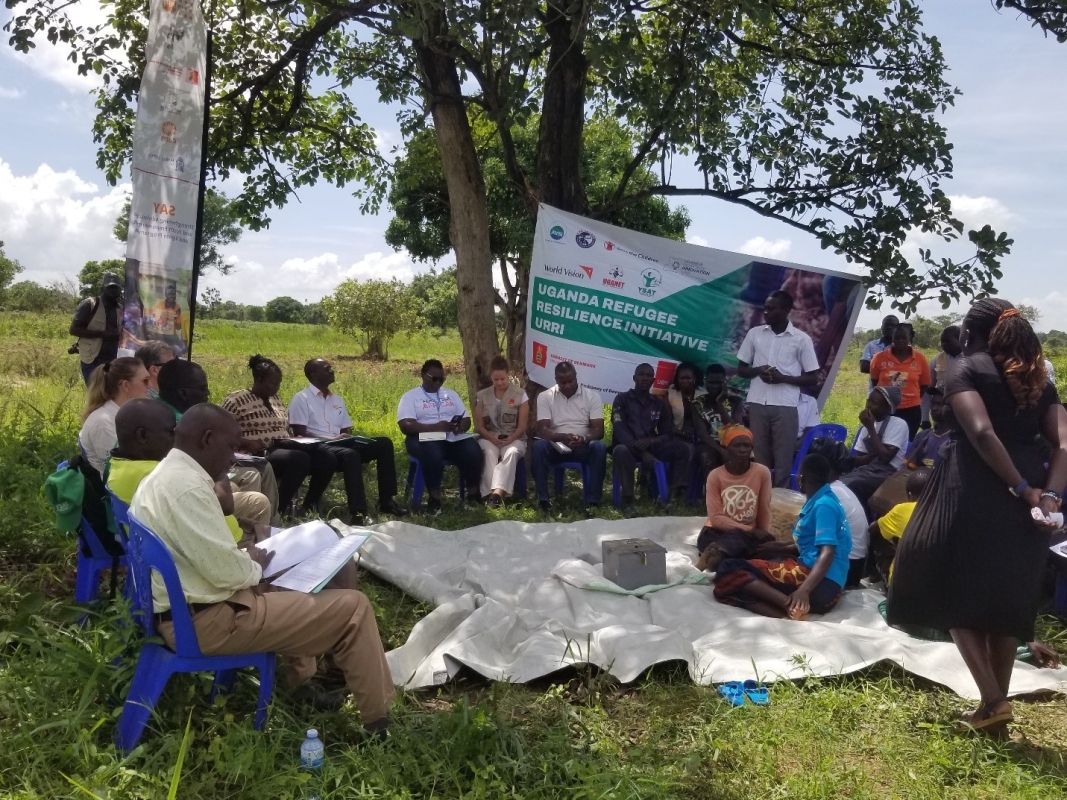
She is one of more than 1,200 young people in Adjumani District who have been trained under the Uganda Refugee Resilience Initiative (URRI) — a government-backed, multi-partner program designed to turn dependency into dignity.
A District under Pressure — and Promise.
To understand Pasi's oven, you must first understand Adjumani.
Nestled in Uganda's West Nile sub-region, this quiet district has become one of the country's largest hosts of refugees fleeing conflict in South Sudan. Today, over 220,000 refugees live alongside approximately 120,000 host community members — a ratio of nearly two refugees for every one Ugandan national.
For years, the dominant narrative was one of strain: pressure on schools, forests, water points, and peace. But the Government of Uganda, working through the Office of the Prime Minister (OPM) and partners like World Vision and the Royal Danish Embassy, has been quietly rewriting that story.
The new narrative is not about managing crisis. It is about unleashing potential.
Skills, Savings, and Self-Worth
The URRI project, now entering its second year in Adjumani and Lamwo districts, targets youth — both refugees and hosts — with training in four key areas: climate-smart agriculture, financial inclusion, sustainable environmental management, and gender-transformative family planning.
Noel Alabi, Program Manager for World Vision overseeing both districts, explains.
“As World Vision, we bring expertise. We lead the climate-smart agriculture component together with sustainable management of environment and natural resources — delivered alongside our partners at YSAT. After one year, we already see positive signs. Farmers are starting to replicate climate-smart practices on their own. And in gender, we are seeing joint planning and decision-making at family and group level,” Alabi said.
The numbers support him.
Within twelve months, active participants have increased their personal savings by an average of 20% — from UGX 500,000 to UGX 600,000 per person. Over 70% of trained farmers have voluntarily adopted climate-smart techniques such as drought-resistant crops and agroforestry. Dozens of micro-enterprises have been born: vegetable stalls, bakeries, goat-rearing projects, and small retail shops.
For Pasi, the transformation has been total.
“I sold my vegetables and used the money to pay my school fees and buy scholastic materials. I even bought a goat last year. And with the money I got from vegetables, I bought an oven,” Pasi said.
She now bakes and sells queen cakes and kebabs alongside tending her garden. She is no longer waiting for aid. She is competing in the local economy.
The Loan That Changed Everything.
Maridio Oliver, another URRI beneficiary, accessed a loan through the program's financial inclusion arm. He is blunt about what works.
“We want to thank the government of Denmark embassy who are supporting us. We want more support so that the young ones who cannot access money can also help themselves,” Maridio said.
That call — for scaled-up financial access — is echoed across the district. Youth do not need handouts, Maridio argues. They need capital, training, and a chance.
The 50:50 Question.
But even in a success story, the government insists on honesty.
Abdul Ramadan, the Settlement Commandant in Adjumani District, carries the weight of daily realities on his shoulders. He praises the URRI model but points to a structural imbalance.
“Currently, refugees get 35% of interventions, and host communities get 65%. But when you look at the population, we are almost going past the number of the host communities as refugees. To me, the intervention should be 50-50. That way, peaceful existence will be spread out,” Abdul said.
He also flags the reduction in food aid — a policy shift intended to encourage self-reliance but which has left some refugees struggling.
“A good number of them are not getting food assistance. They struggle for their own food, their own livelihood. But sometimes they are limited by resources — they cannot get land, cannot hire land. They want to do business, but the market is not there. If they are empowered, they will stand on their own,” Abdul said.
Government's Response.
Obumai Simon Peter, Assistant Resident District Commissioner of Adjumani, does not shy away from the gaps. But he also refuses to let them erase progress.
“It is not that the government is doing nothing. We are doing what we can. But because of the open-door policy — which also has its challenges — more refugees are still coming. The NURI and URRI projects are addressing some of those gaps. We are receiving new arrivals. Some of these interventions are for those who just came, the ones who missed NURI, and now they are benefiting,” Obumai said.
He addresses development partners directly.
“If there are other opportunities — because the gaps have been identified — you are no longer friends now. You are brothers. Continue to support your brothers,” Obumai said.
The Quiet Revolution.
Despite the challenges, something is shifting in Adjumani.
It can be seen in Brenda Pasi's savings account. In Maridio Oliver's repaid loan. In the fields where young farmers are trying drought-resistant seeds for the first time. In the kitchens where queen cakes come out of locally bought ovens.
The URRI project is not a cure-all. But it is a proof of concept.
When given skills, capital, and a policy environment that allows them to work, own land, and trade — as Uganda's refugee policy uniquely does — young people do not remain victims. They become vegetable farmers. Bakers. Savers. Students. Entrepreneurs.
They become, in other words, exactly what the Government of Uganda has always said they could be.
As Abdul put it, reflecting on the Adjumani experience:
“Hospitality without empowerment is incomplete. In Adjumani, we are completing the circle — one garden, one loan, one queen cake at a time,” Abdul said.
For Brenda Pasi, that circle is already paying dividends.
She smiles when asked about the future.
“I am saving for a bigger oven,” she says.
And then she returns to her garden.
END.